
Indoor, outdoor, covered outdoor: definitions
When planning a padel court, the first decision is where to put it. There are three options.
- Indoor: the court is installed inside a building, either existing or purpose-built. It is protected from the weather and usually relies on artificial light.
- Outdoor: the court is in the open, exposed to sun, rain, wind and temperature swings.
- Covered outdoor: the court is outdoors but has a cover structure over it, which shelters it from bad weather without enclosing it in a building.
The court itself is the same: the playing dimensions do not change from one option to another. What changes is the space needed around and above it, the structure to plan for and how the court can be used through the year.
The comparison
The table compares the three options on the points that weigh most in the decision.
| Aspect | Indoor | Outdoor | Covered outdoor |
|---|---|---|---|
| Use through the year | All year | Tied to the season and the weather | All year, sheltered from bad weather |
| Weather dependence | None | High: rain and cold stop play | Reduced |
| Structure required | A suitable building, existing or new | Only the court and its base | The court plus the cover structure |
| Free height | Set by the building, must be checked | No limit above the court | Set by the cover, must be planned in the design |
| Lighting | Usually artificial | Needed for evening play | Needed under the cover |
| Choice of turf | The setting is one of the criteria | The setting is one of the criteria | The setting is one of the criteria |
| Maintenance | More stable conditions | Exposed to the weather and debris | Reduced exposure |
| Investment | Depends on the building: higher if it must be built | Limited to the court and base | The cover is added to the court |
No option is best in every case. A centre in an area with long, wet winters has different needs from a club that does most of its business in the warmer months.
Free height
Height is where indoor and covered courts get complicated. The International Padel Federation Rules of Padel require a minimum free height of 6 metres over the whole court, with no obstructing elements such as light fittings. For new facilities, they suggest 8 metres.
If you want to allow out-of-court play through the side openings, the same rules require, on each side, an obstacle-free area at least 3 metres wide (4 metres recommended), 4 metres long and at least 3 metres high. In a building, walls or columns too close to the court can rule this out.
In an existing building, height is the first thing to check, before any other decision: if there is not enough, the court cannot go there. In a covered facility, it is a parameter to set in the design when choosing the cover. The other clearances to plan, such as the margins around the structure, are in our guide on how much space a padel court needs.
The middle way: an outdoor court with a cover
Between indoor and outdoor there is a third route: install the court outdoors and cover it. You get year-round use without needing a building, and a cover can also be considered later, for an existing court.
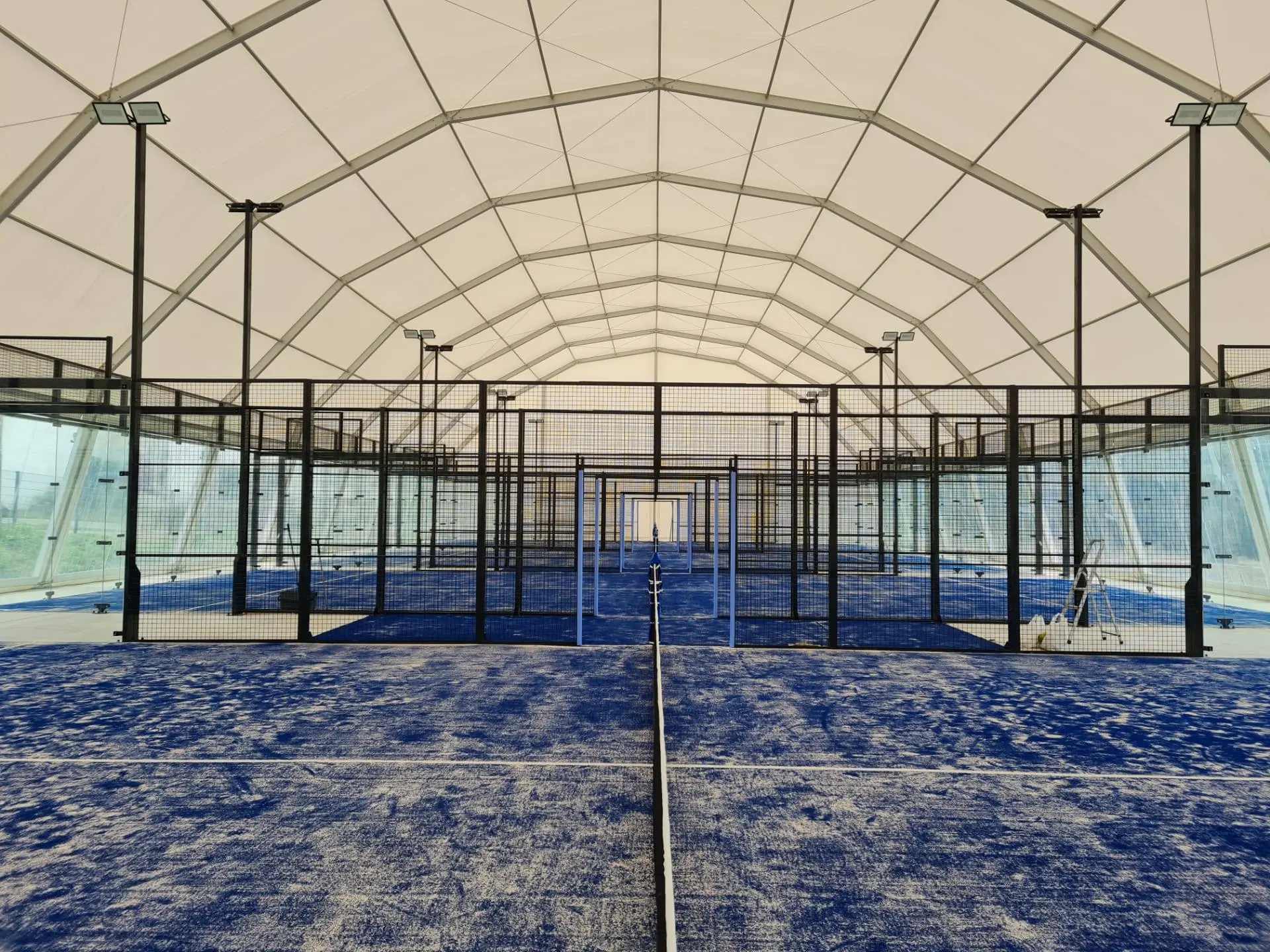
Covers are among the complementary solutions in our turnkey service: we supply them and assess with the client which one suits the facility. Three things need to be considered in the design:
- free height under the cover, in line with the figures above;
- permits, which for a cover structure depend on the context and local regulations, and should be checked with a qualified professional;
- lighting, which under a cover is also needed during the day, when natural light is not enough.
Evening play
Indoors, outdoors or covered, a court that can be booked after sunset works more hours a day. That is why lighting belongs in the design, not as an extra added later.
On our courts, LED lighting on dedicated poles is included in the supply. Outdoors, it makes the most requested evening hours available. Indoors and under a cover, artificial light is needed at every hour instead, and has to be designed together with the building or structure.
How to decide
To choose between the three options, answer these questions in order:
- In which months do you want the court to be bookable? If the answer is all year, an uncovered outdoor court is not enough in areas with wet or cold seasons.
- Do you already have a suitable building? If so, check the free height and the space around the court first.
- Do you have outdoor space? If so, consider an outdoor court, with or without a cover.
- How much do evening hours matter to your bookings? Plan the lighting from the start.
- How will the court be used? Intensity of play and setting also guide the choice of turf, covered in our guide on when to replace the turf.
- Which permits are needed? For a new building or a cover, check with a qualified professional and the local authorities before fixing the schedule.
- Do you want room to grow? An outdoor court can also be covered later, if the layout allows for it: planning for this from the start avoids redoing work.
If you are planning a whole centre, our guide on how to open a padel club puts this choice in sequence with the others.
TP Padel court features
The Panoramic court measures 20×10 m, with FIP regulation dimensions, and is suitable for official competitions and tournaments; the Panoramic Single court measures 20×6 m. The structure is galvanised steel with electro-welded mesh panels and a RAL colour of your choice, the walls are safety tempered glass in 3×2 m panels, and the synthetic turf is available fibrillated, monofilament or texturised.
To find out which option suits your space, contact us.