
What a beach volleyball court is and how big it is
A beach volleyball court is a rectangular sand playing area, divided in half by a net, played by teams of two. In a sports centre it is a permanent facility designed for regular use, not a court set up for one season on a beach.
The reference dimensions come from the FIVB Official Beach Volleyball Rules, 2025–2028 edition:
- the playing court is a rectangle of 16×8 m;
- around it there is a free zone at least 3 m wide on all sides, which rises to 5–6 m for FIVB, World and Official Competitions;
- above the playing area you need free playing space, clear of obstructions, at least 7 m high, or 12.5 m for FIVB, World and Official Competitions.
The real footprint is therefore much larger than the court itself: with the minimum free zone, the area taken up is about 22×14 m.
The lines
The same rules specify lines 5 cm wide, in a colour that contrasts with the sand. They must be ribbons of a resistant material, and any exposed anchors must be soft and flexible. The lines sit inside the court dimensions and there is no centre line: the net does the dividing.
This is a safety rule: in beach volleyball players fall and dive onto the sand, and the lines must not create rigid points.
The sand
The sand is the playing surface, and its quality determines comfort and safety. The FIVB rules require levelled sand, as flat and uniform as possible, free of rocks, shells and anything else that could cause cuts or injuries. For FIVB, World and Official Competitions they also specify:
- a depth of at least 40 cm;
- fine, loosely compacted grains;
- sifted sand, neither too coarse nor too fine, so that it does not raise dust or stick to the skin.
For a sports centre these are good criteria even outside competition. Selected, sifted sand keeps the court soft under bare feet without scattering during play.
Heating the sand bed
Outdoors, the sand follows the air temperature: in winter and on days with strong temperature swings it cools quickly, and playing barefoot becomes uncomfortable. A heating system built into the sand bed counters this cooling and keeps the surface at a more comfortable, consistent temperature.
The result is a court that can be used for more months of the year, including the colder season, rather than only in summer.
Lighting
As with padel, a lit court also works in the evening. For beach volleyball, the LED system is mounted on curved support structures that direct the light onto the playing area, limiting glare and shadows for the athletes.
For FIVB, World and Official Competitions played at night, the rules call for lighting on the playing area of 1,000 to 1,500 lux, measured 1 m above the surface. That is the reference for hosting international night competitions; for the centre's everyday use, the system is sized to actual needs.
The adjustable net
The net goes up or down depending on who is playing. The FIVB rules set its height at 2.43 m for men and 2.24 m for women, with lower heights for youth age groups:
| Category | Net height |
|---|---|
| Men | 2.43 m |
| Women | 2.24 m |
| 16 and under | 2.24 m |
| 14 and under | 2.12 m |
| 12 and under | 2.00 m |
An adjustable-height net lets you use the same court for adults, women's teams, courses and youth programmes without changing equipment.
How to plan the court: the steps
Every court adapts to its site. The variables to assess, in the order it makes sense to tackle them:
- The available space and its layout. Beyond the 16×8 m court you need the free zone around it, at least 3 m on each side, and the free space overhead.
- Drainage of the area. Rainwater must not stand in the sand: plan how it will be drained away.
- Exposure and orientation. The position of the court relative to the sun affects play at different times of day.
- The sand. Type, selection and depth, starting from the FIVB criteria described above.
- Lines and net. Flexible 5 cm ribbon lines and a net that adjusts for different categories.
- Lighting for evening play. Sized for the intended use, with the FIVB reference if you want to host international night competitions.
- Sand heating, if you want to use the court in the colder months as well.
Many of these choices are made once, at the design stage: it pays to settle them before work starts.
Beach volleyball and padel in the same centre
Beach volleyball and padel complement each other. Beach volleyball makes use of outdoor space, attracts players who are partly different from padel players and works well in the warm season, which sand heating can extend. The two facilities share the centre's services, such as reception, changing rooms and parking, and make it possible to run tournaments, courses and events across more than one sport.
For a padel centre with outdoor space, a beach volleyball court is a way to broaden the offering without overhauling the facility. The steps for planning a complete centre are in our guide on how to open a padel club.
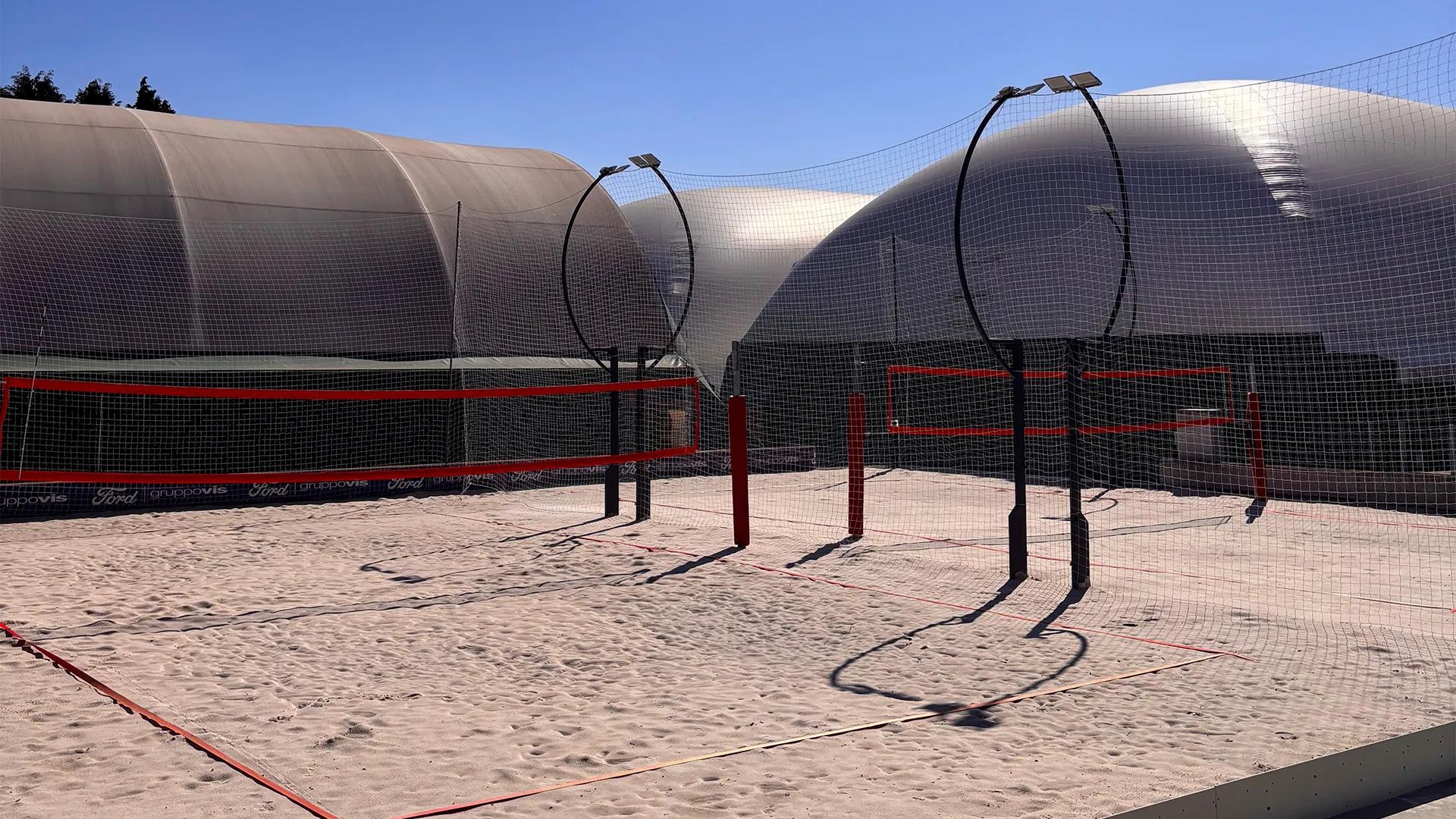
TP Beach Volley specifications
The TP Beach Volley court is designed for sports centres. Its features:
| Specification | TP Beach Volley |
|---|---|
| Playing area | 16×8 m |
| Lines | Flexible, 5 cm wide |
| Sand | Selected and sifted, minimum depth 40 cm |
| Heating | Sand bed heating system |
| Lighting | LED on curved structures; for international night competitions, 1,000–1,500 lux in line with FIVB requirements |
| Net | Adjustable height |
Our completed projects include Beach Volley Bellavista in Varese.
If you are thinking of adding beach volleyball to your centre, contact us.