
What a turnkey supply is
A turnkey padel court is a supply in which a single party manages the whole project, from technical consultancy to after-sales, and hands over a court that is ready to play on. The client deals with one contact, who coordinates every phase and is accountable for the result.
It is the opposite of a supply-only arrangement, where the supplier delivers the components and the client organises installation, site works and support on their own. Both models exist and both can work: what changes is who takes on the coordination.
The five phases
A turnkey project goes through five phases, always in the same order.
| Phase | What happens | What the client receives |
|---|---|---|
| 1. Technical consultancy | Assessment of the space, the project requirements and the technical constraints | An evaluation of the site and the available options |
| 2. Design | Definition of configuration, dimensions, finishes and customisation | The court design, with model, turf and colours defined |
| 3. Production | Manufacturing of structures and components in the production facilities | The components produced for their project |
| 4. Installation | Specialised assembly carried out by dedicated teams | The court assembled on site, ready to play |
| 5. After-sales | Technical support, spare parts and ongoing assistance | A single point of contact after opening too |
The phases are the same for a single court and for a centre with several courts. What changes is how complex the consultancy and design work is, not the sequence.
Turnkey or supply only
The choice between the two depends on how much the client wants, or is able, to manage the project directly. The comparison is about organisation, not price.
| Aspect | Turnkey | Supply only |
|---|---|---|
| Contacts | One, for the whole project | Several: supplier, installer, other contractors |
| Coordination | Handled by the supplier | Handled by the client |
| Responsibility for the result | With a single party | Shared among the parties involved |
| Scheduling | One timeline, managed by the supplier | Separate timelines to align |
Supply only can make sense for clients with an in-house technical team and installers they already trust. For anyone opening a sports centre or adding courts to an existing facility, turnkey means fewer handovers and a clearer answer to the question of who to call.
What the client still decides
Turnkey does not mean handing over every decision. The supplier coordinates, but some choices stay with the client, because they define the court and how it will be used.
- The model. The Panoramic court, 20×10 m, has FIP regulation dimensions and is suitable for official competitions and tournaments. The Panoramic Single court, 20×6 m, is designed for one-on-one play, coaching and compact spaces.
- The playing surface. Fibrillated, monofilament or texturised synthetic turf, in several colours. The differences between the three types are covered in our guide on when to replace the turf.
- The look. The structure colour, any RAL reference you choose, and your sports centre's logo on the net and side posts.
- Complementary solutions, described below.
- The opening date, which becomes the point the project schedule is planned back from.
Ready delivery in 17 days
With our turnkey service there are 17 days from order signature to installation. Knowing that date in advance lets you plan the opening, the first bookings and the launch of your centre.
The figure refers to the court. The overall project timeline also depends on permits and on-site works, which need to be checked separately: our guide on installation time covers this.
For projects outside Italy, transport and installation are agreed separately.
Complementary solutions
The court is at the heart of the project, but it is rarely the only thing to decide. A turnkey service can also include:
- outdoor flooring or resin, for the areas around the court;
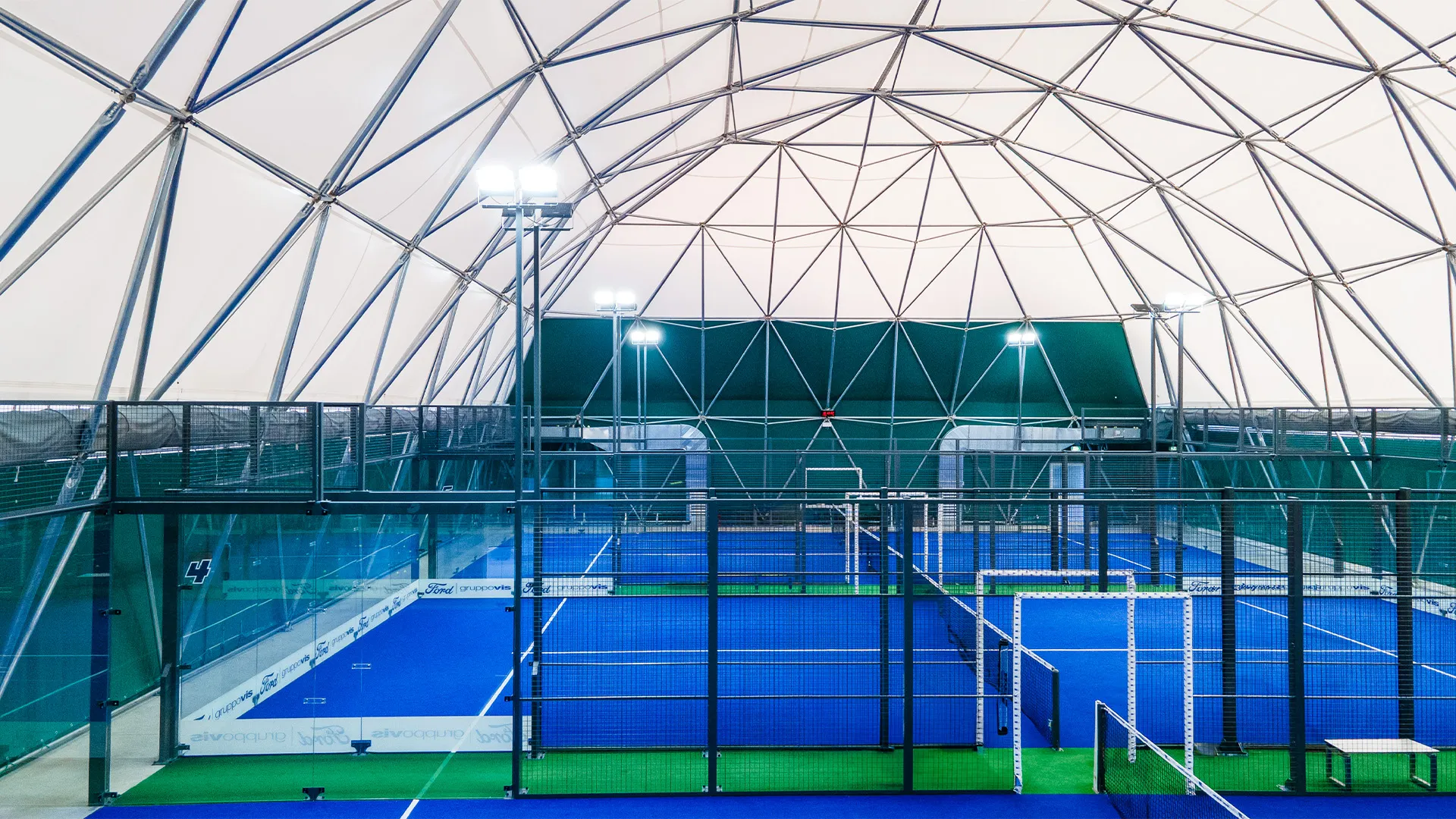
- covers, to use the facility all year round;
- glass graphics, meaning graphic customisation of the glass surfaces;
- post protections, fitted to the perimeter posts;
- heating for the playing area.
LED lighting on dedicated poles and customisation with your sports centre's logo on the net and side posts are already part of the court supply. Covers are supplied as a complementary solution: we assess together which one suits the facility.
What to define before you start
Some points need to be clear before the order, because they determine timing and feasibility. They are checked during the site visit.
- The available space. Beyond the playing area you need clearances around the structure and adequate free height, more if the court is covered. Our guide on how much space a padel court needs has the figures.
- The base. The court is installed on a flat, level surface, and the condition of the existing base must be assessed on site.
- Permits. They depend on the context and on local regulations: check them with a qualified professional and the local authority before fixing dates.
- The layout. Position and orientation of the courts, access routes, service areas and space for spectators.
- Complementary solutions. Cover, lighting and heating affect the project and are best decided at the start.
What to ask for in a turnkey offer
A turnkey service is only as good as the supplier behind it. A complete offer should state, in writing:
- which of the five phases it covers, and any exceptions;
- the model, turf and finishes included;
- who carries out the installation;
- the time from order signature to installation;
- which complementary solutions are included and which are optional;
- what remains the client's responsibility, such as foundation works and permits;
- how after-sales support works, including replacement of glass and turf.
With these items, different proposals become comparable. The other criteria for assessing a supplier, from materials to references, are in our guide on how to choose a padel court manufacturer.
To work out how to set up your turnkey project, contact us.