
Manufacturer, reseller, installer: what is the difference
Anyone looking for a padel court will deal with three different roles, which often present themselves in the same way. Telling them apart is the first step towards comparing offers on equal terms.
- Manufacturer: designs and builds the court structure, or its main parts, in its own facilities. It knows the materials from the source and is directly accountable for how they are made.
- Reseller: sells courts built by someone else. It can offer good service, but for specifications, spare parts and lead times it depends on the manufacturer behind it.
- Installer: assembles the court on site. It may work for a manufacturer, for a reseller or independently.
The three roles can sit within a single company or be three separate businesses. The difference matters most after you sign: when you need a spare part, when a date slips, or when you need to establish who is responsible for a defect. The more hands a court passes through between production and installation, the more important it is to have responsibilities in writing.
The criteria to assess
To compare two suppliers, use the same criteria and ask both of them the same questions, in writing. The table below sums up the key points.
| Criterion | What to ask | Why it matters |
|---|---|---|
| Structure and materials | Structural material, corrosion protection, type of panels | The structure carries the glass and mesh for the whole life of the court |
| Safety tempered glass | Type of glass and panel format | The glass is both a playing wall and a safety element |
| Playing surface | Type of synthetic turf and available colours | The turf affects play and maintenance |
| Regulation dimensions | Interior court dimensions and compliance with FIP rules | Required to host official tournaments and competitions |
| Customisation | Structure colours, logos, finishes | The court is also the face of your sports centre |
| Delivery time | Time from order signature to installation, in writing | Every week of delay is a week without bookings |
| Installation | Who installs, with which teams, who coordinates the site | Correct assembly preserves performance over time |
| After-sales and spare parts | How and how quickly glass and turf are replaced | A broken pane takes the court out of use until it is replaced |
| References | Completed installations, ideally ones you can visit | Seeing a court in use tells you more than a data sheet |
| Turnkey service | Whether the supplier manages the whole project as a single point of contact | Fewer handovers and clearer responsibilities |
| Documentation | Written technical specifications of the materials | Makes different offers comparable on the same data |
For dimensions, the reference is the International Padel Federation (FIP) Rules of Padel: the court is a rectangle 10 metres wide and 20 metres long, measured inside, with a 0.5% tolerance. If you plan to host official tournaments, start from there. The single format, 6 metres wide, is a different choice, intended for one-on-one play, coaching and compact spaces.
Questions to ask before you sign
Before signing an order, get a written answer to these questions:
- Who manufactures the structure, the glass and the turf, and where?
- What are the technical specifications of the materials, in writing?
- Do the interior court dimensions comply with the FIP rules?
- How long is it from order signature to installation?
- Who carries out the installation, and who coordinates the site?
- What does the offer include, and what is left to you, such as foundation works, transport and utility connections?
- How does after-sales support work, and how quickly can a glass panel or the turf be replaced?
- Which installations have you already completed, and can they be visited?
The answers do more than help you choose: they become the basis of the contract and your reference point if something does not go to plan.
Warning signs
Some situations are not necessarily a problem, but they deserve a follow-up question.
- A quote without a site visit. The site determines the base, the space and the access for the works: an offer made without seeing it may change along the way.
- No written specifications. Materials described only verbally, or with vague adjectives, cannot be compared.
- No stated lead time. A missing or vague delivery date makes it impossible to plan your opening.
- No references. A supplier with nothing to show is not necessarily unreliable, but you have nothing to verify.
- Fragmented responsibility. If every phase has a different contact, make clear who coordinates the work and who is accountable for the result.
How to compare two offers
Two quotes can only be compared if they describe the same court. Before looking at the figures, line up the items: double or single version, turf type, lighting, any cover, foundation works, transport and installation. A price gap often comes from an item that appears in one offer and not in the other. Our guide on how much a padel court costs lists the factors that drive the cost.
A simple method is to ask every supplier to fill in the same criteria table. Missing answers are information in themselves.
Made in Italy: what to check
"Made in Italy" is only useful when it is specific. For a padel court, ask where the main components are designed and produced, meaning the structure, the glass and the turf, and get the answer in writing together with the specifications. That turns the origin into something you can verify rather than a generic label, and lets you compare offers that use the same claim on their merits.
How TP Padel works
We apply the same criteria to ourselves.
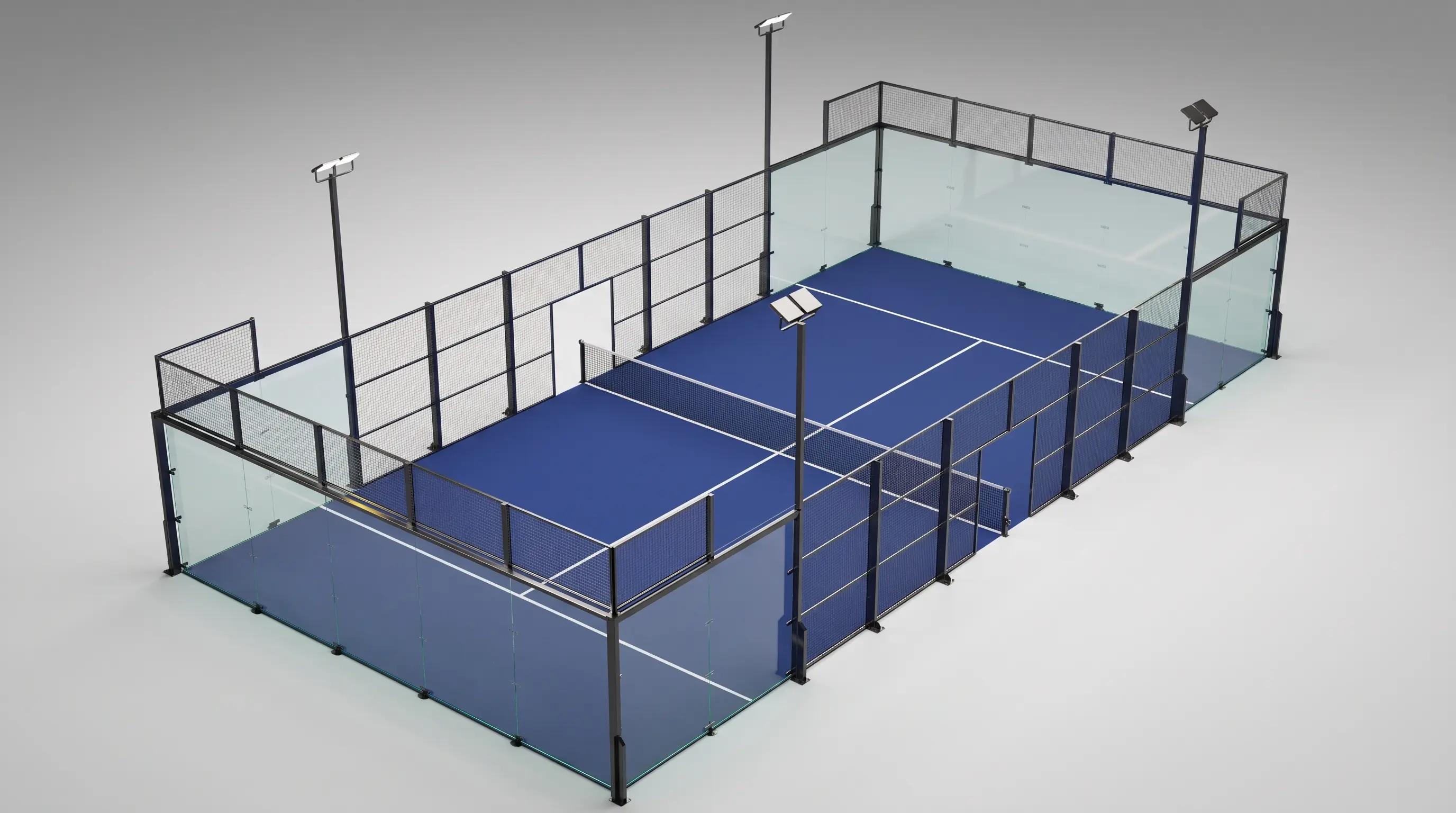
- Production: we design, manufacture and install fully Made in Italy padel courts, through a single supply chain covering technical consultancy, design, in-house production, installation and after-sales.
- Structure: galvanised steel, electro-welded mesh panels, RAL colour of your choice.
- Glass: safety tempered glass, in 3×2 m panels.
- Playing surface: fibrillated, monofilament or texturised synthetic turf, in several colours.
- Dimensions: the Panoramic court measures 20×10 m, with FIP regulation dimensions, and is suitable for official competitions and tournaments. The Panoramic Single court measures 20×6 m and is designed for one-on-one play, coaching and compact spaces.
- Customisation: your sports centre's logo on the net and side posts.
- Lighting: LED fixtures on dedicated poles, included in the supply.
- Lead time: ready delivery, with 17 days from order signature to installation. Our new production plants and large warehouses allow fast delivery of materials.
- After-sales: prompt replacement of tempered glass panels and synthetic turf.
- References: our completed projects include Clover Sport in Milan, SmashX3 Bellavista in Varese, SmashX3 Greenpadel in Cardano al Campo and installations in Macerata and Cosenza.
- Turnkey: with our turnkey service you have a single point of contact for the whole project.
If you are comparing suppliers, get in touch: we will come back to you with an assessment of your project.